
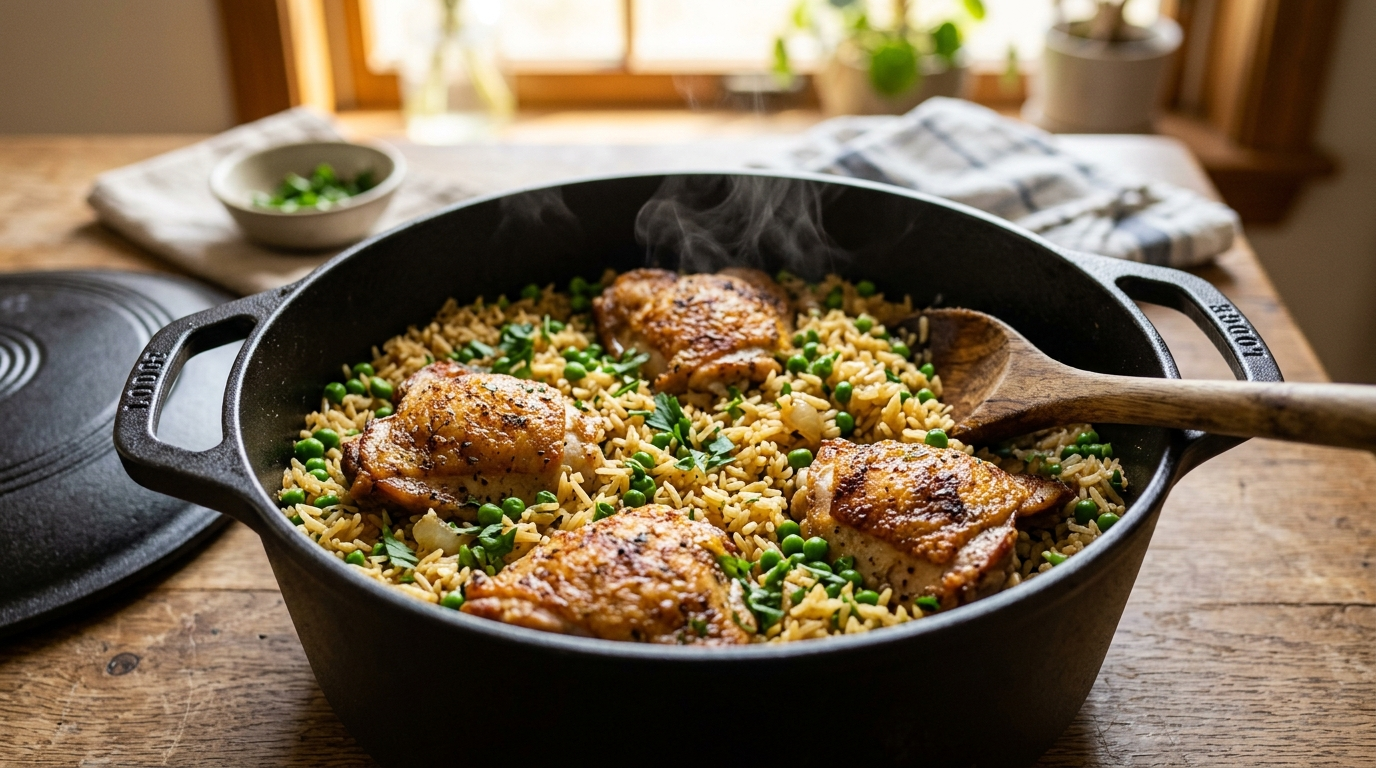
Easy Chicken and Rice recipes: 3 Foolproof Methods (One-Pot, Sheet Pan, Slow Cooker)
Table of Contents
Chicken and rice is the dinner I make when I don’t want to think. I’ve burned the bottom of the pot, ended up with crunchy rice more times than I’ll admit, and finally figured out the one ratio that fixes both. These three versions are what’s actually in my rotation — pick based on how much attention you have to give it tonight.
“Chicken and rice” isn’t one recipe — it’s a method that changes completely depending on how much time and attention you have. Below are three real, complete versions: one-pot stovetop (30 minutes, needs occasional attention), sheet pan (40 minutes, mostly hands-off), and slow cooker (4-6 hours, fully hands-off). First, the one rule that fixes 90% of what goes wrong with any of them.
Which One Should You Make Tonight?
| If you have… | Make… |
|---|---|
| 30 minutes and one working burner | One-Pot |
| Kids who need to eat now, hate a messy stovetop | Sheet Pan |
| A full workday and want dinner ready when you’re home | Slow Cooker |
| Meal prep for the week | Slow Cooker (doubles easily) |
| Never made this before | One-Pot — hardest to mess up once you nail the ratio |
The Only Rule That Actually Matters: Get the Ratio Right
Almost every “my rice came out mushy/crunchy/burnt” problem traces back to one thing: the liquid-to-rice ratio, not skill.
| Rice type | Liquid : Rice ratio | Simmer time | Rest time |
|---|---|---|---|
| Long-grain white | 2 : 1 | 18 min | 10 min, covered |
| Jasmine | 1.5 : 1 | 15 min | 10 min, covered |
| Basmati (rinsed) | 1.5 : 1 | 15 min | 10 min, covered |
| Brown rice | 2.5 : 1 | 40–45 min | 10 min, covered |
Three habits on top of the ratio fix almost everything else:
- Rinse white rice until the water runs clear (30–60 seconds under cold water in a fine-mesh strainer). This washes off surface starch — skip it and you get gluey, clumped grains no matter how careful the ratio is.
- Don’t stir once it’s simmering. Stirring releases starch and makes rice sticky, the same way stirring risotto on purpose makes it creamy. Lid on, heat low, hands off.
- Always rest it, covered, off heat, for 10 minutes before fluffing. The residual steam finishes cooking the center grains evenly. Fluff with a fork, never a spoon — a spoon crushes grains, a fork separates them.
Chicken doneness, regardless of method: 165°F (74°C) in the thickest part, always — per USDA guidance. Color and texture aren’t reliable; an instant-read thermometer is the only real test, especially in a mixed dish where the chicken is partly hidden in rice and hard to eyeball.
Method 1: One-Pot Stovetop Chicken and Rice (30 Minutes)
The weeknight default — one pot, mostly stovetop attention, done in half an hour.
Serves 4 | Prep 10 min | Cook 20 min
Ingredients
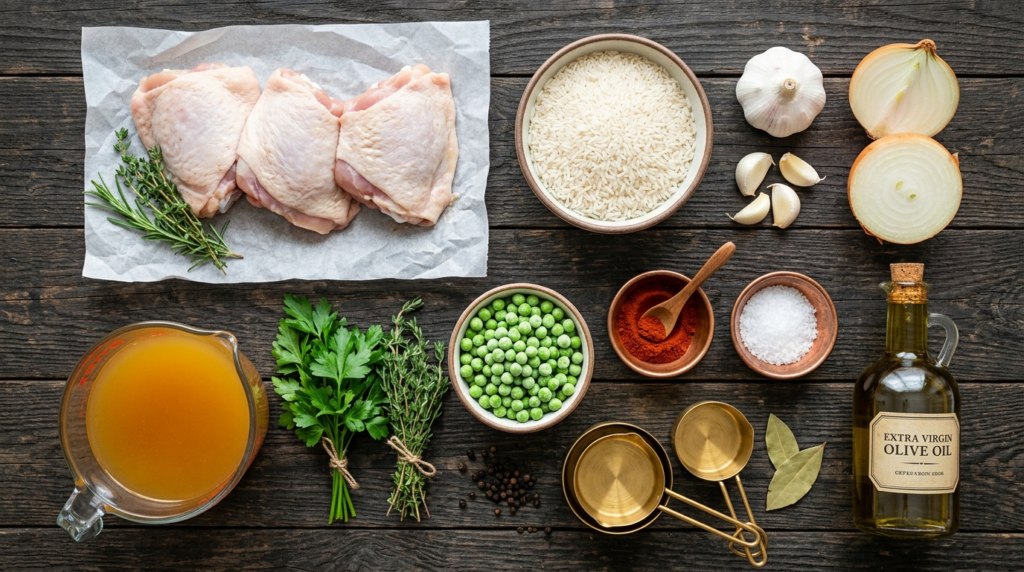
- 500g (about 1 lb) boneless, skinless chicken thighs, cut into 2cm pieces
- 1 tbsp olive oil
- 1 small onion, diced
- 2 cloves garlic, minced
- 1 cup (185g) long-grain white rice, rinsed until water runs clear
- 2 cups (475ml) low-sodium chicken broth
- 1 tsp dried thyme, 1/2 tsp paprika, salt and pepper to taste
- 1 cup (150g) frozen peas
- Fresh parsley, chopped, to finish
Method
- Pat chicken dry. Season with salt, pepper, and paprika. If you crowd the pan in the next step, the chicken releases water instead of browning — I learned this the hard way after wondering for months why mine always came out gray instead of golden.
- Heat oil in a heavy-bottomed pot or Dutch oven over medium-high. Brown chicken in batches (don’t crowd it — see above), 3–4 minutes per side. Remove and set aside; it won’t be fully cooked yet, that’s fine.
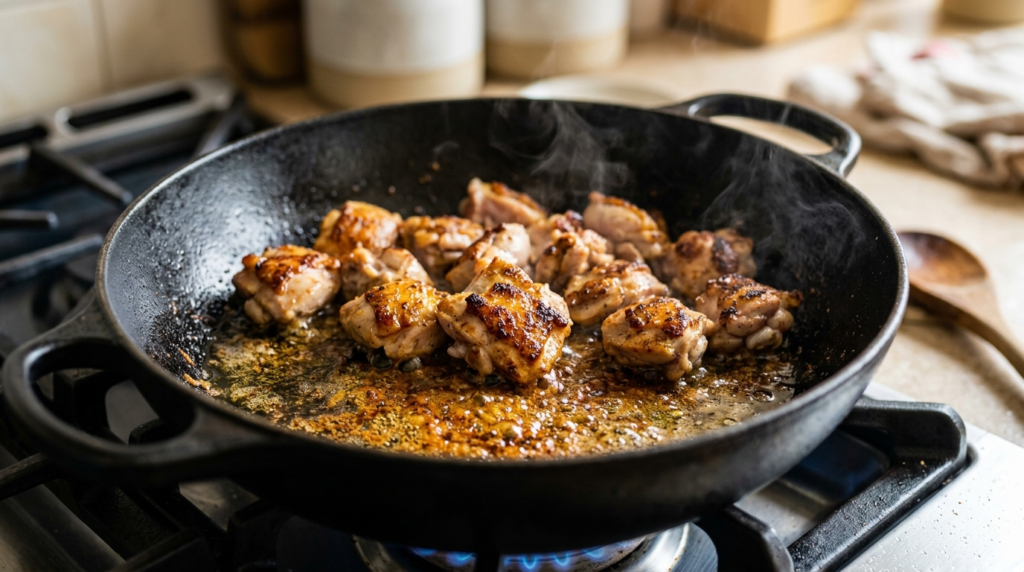
- Same pot, medium heat: onion 3 minutes, garlic 30 seconds — you want it fragrant, not browned.
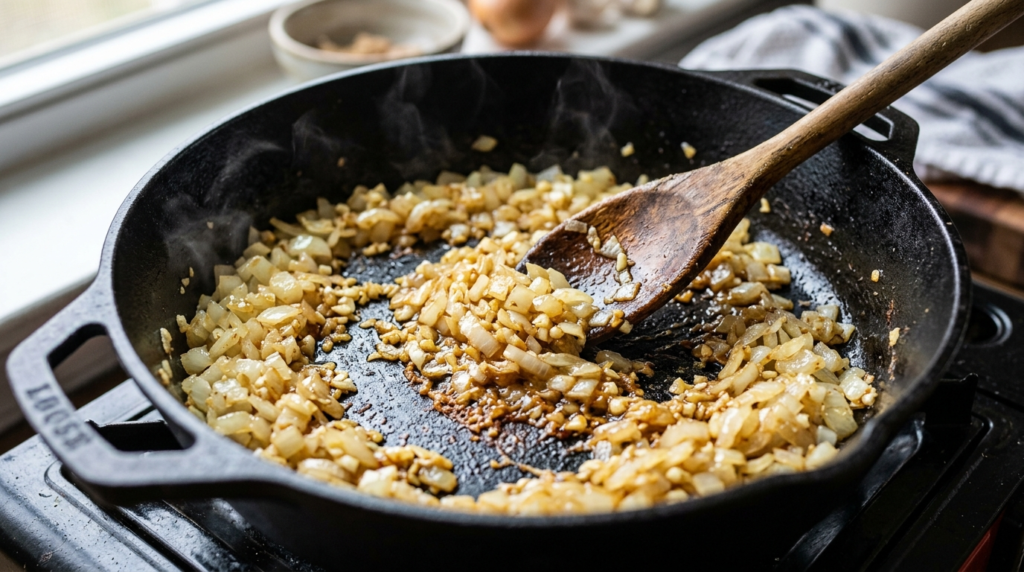
- Add rinsed rice, stir 1 minute to coat in the fat and aromatics. This step is easy to skip and shouldn’t be — it’s what gives the finished rice a rounder, slightly toasted flavor instead of tasting like plain boiled grains.
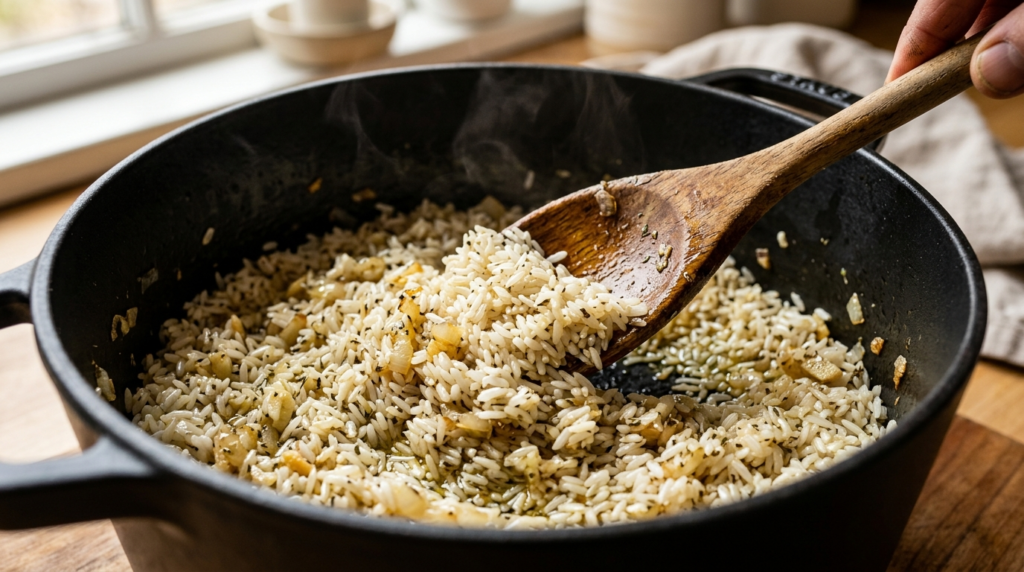
- Pour in broth, add thyme, scrape up any browned bits from the bottom (that’s flavor, not mess). Return chicken and any juices to the pot.
- Bring to a boil, then immediately drop to the lowest simmer, cover, and set a timer for 18 minutes. Do not stir. Do not lift the lid — every peek lets steam escape that the rice needs.
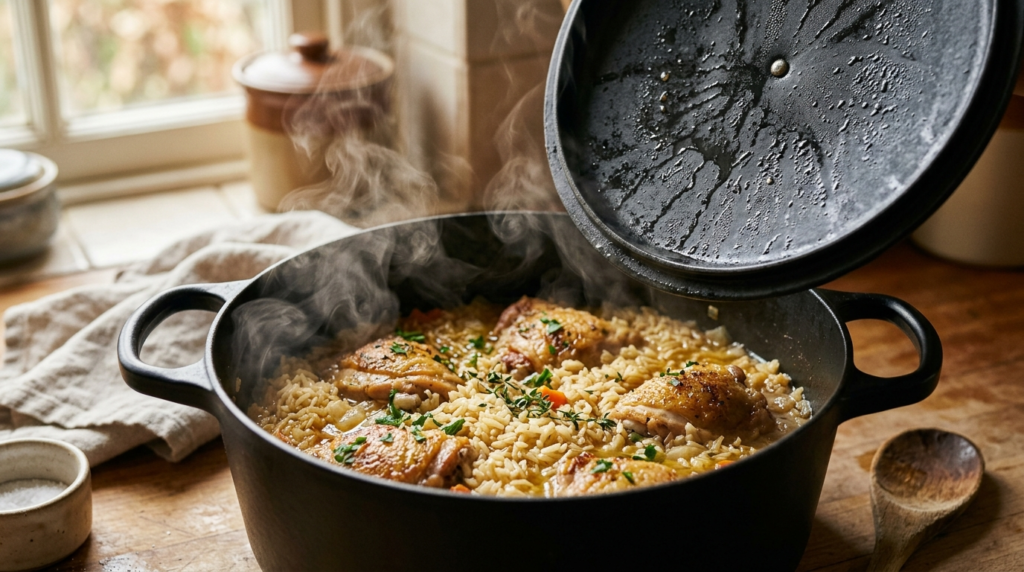
- Off heat, let rest covered 10 minutes. Fold in frozen peas straight from frozen (residual heat cooks them through without turning them dull and khaki-colored) and fork-fluff. Check chicken hits 165°F. Parsley on top.
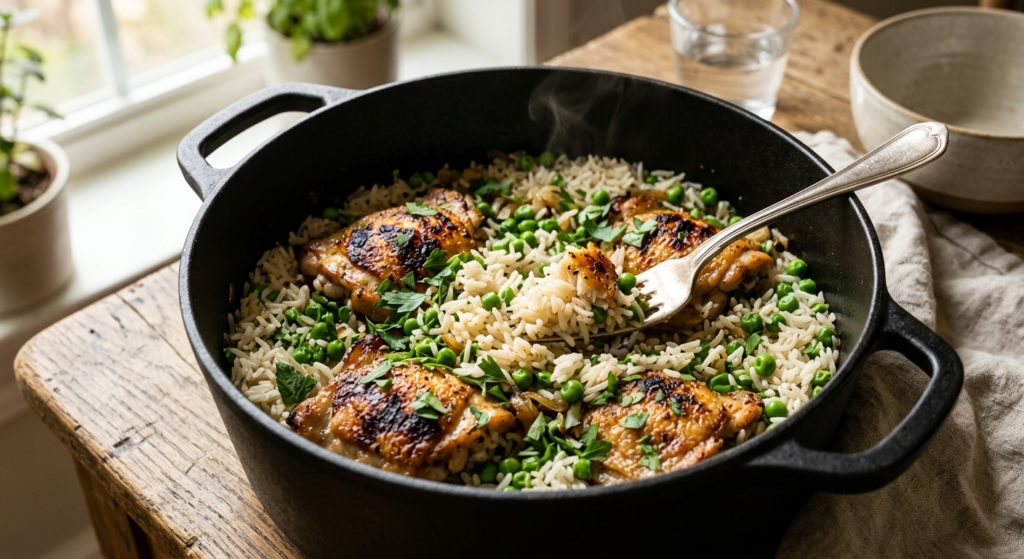
Macros (per serving): ~410 calories | 32g protein | 42g carbs | 12g fat
Why This Recipe Works
✓ Browning the chicken first builds a fond (the browned bits) that flavors the whole pot — skipping this step is the single biggest flavor loss in a rushed version.
✓ Toasting the rice in the fat before adding liquid gives it a rounder flavor than rice boiled straight in broth.
✓ The broth (not water) does double duty as seasoning and cooking liquid.
✓ Peas go in after cooking, off the heat, so they stay bright green instead of turning that grayish-green frozen-veggie color from being boiled with everything else.
✓ The 10-minute rest lets steam finish the center grains without the bottom overcooking.
Method 2: Sheet Pan Chicken and Rice (40 Minutes, Mostly Hands-Off)
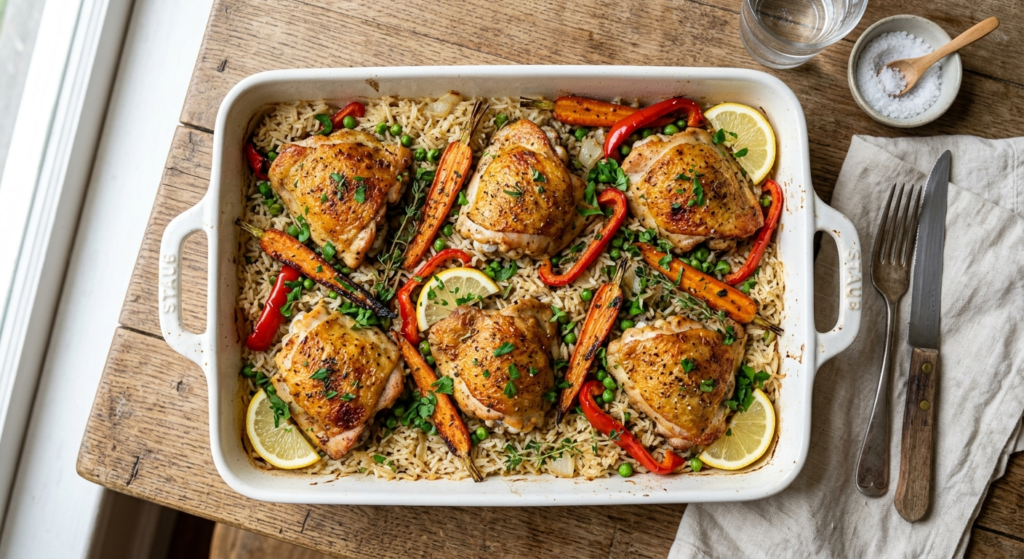
For when you want dinner in the oven and your hands free.
Serves 4 | Prep 10 min | Cook 30 min
Ingredients
- 700g (1.5 lb) bone-in, skin-on chicken thighs (4–6 pieces)
- 1 cup (185g) long-grain white rice, rinsed
- 2 cups (475ml) hot chicken broth
- 1 red bell pepper, sliced into strips
- 1 cup (110g) carrots, sliced thin
- 2 tbsp olive oil, divided
- 1 tsp smoked paprika, 1 tsp garlic powder, 1/2 tsp oregano, salt and pepper
Method
- Preheat oven to 400°F (200°C). Pat chicken dry, rub with 1 tbsp oil and half the spice mix.
- Spread rinsed rice evenly in a 9×13 baking dish or deep sheet pan. Scatter carrots (they need the head start) over the rice. Pour hot broth over everything — hot broth matters here; cold broth drops the pan’s temperature and throws off the whole timing.
- Nestle the chicken pieces on top, skin-side up, so they sit above the liquid rather than submerged — this is what gets you crisp skin instead of soggy skin.
- Cover tightly with foil. Bake 20 minutes covered.
- Uncover, scatter bell peppers over the rice around the chicken, drizzle chicken with remaining oil and spices. Bake uncovered 10 more minutes, until chicken skin is golden and reads 165°F, and rice has absorbed the liquid.
- Rest 5 minutes before serving straight from the pan.
Macros (per serving): ~460 calories | 34g protein | 38g carbs | 18g fat
Method 3: Slow Cooker Chicken and Rice (4–6 Hours, Fully Hands-Off)
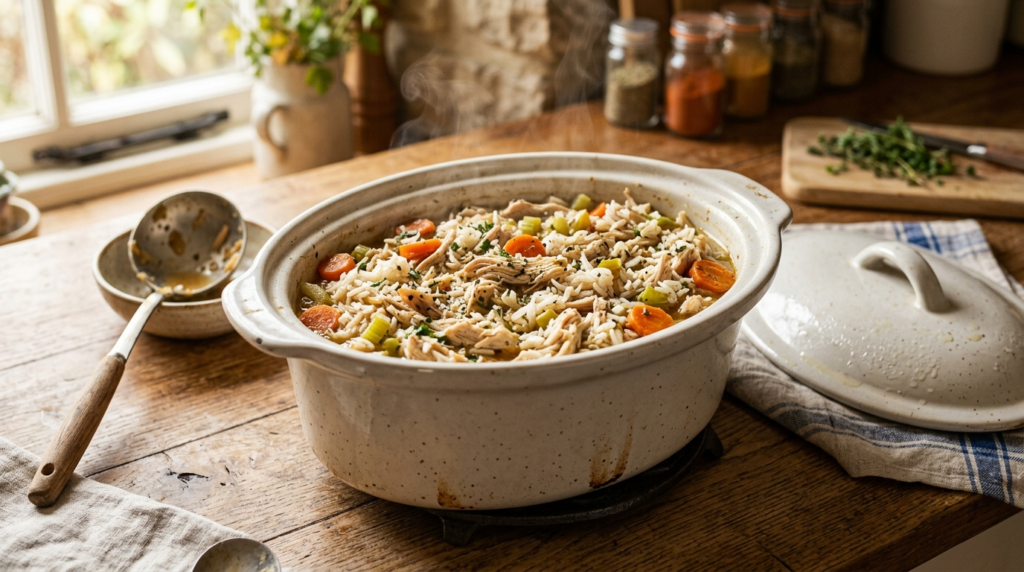
Best for a full day out of the kitchen — but rice goes in late, not at the start, or it turns to paste.
Serves 4–5 | Prep 10 min | Cook 4–6 hrs
Ingredients
- 700g (1.5 lb) boneless, skinless chicken thighs (breasts work — see note)
- 1 onion, diced; 2 carrots, sliced; 2 celery stalks, sliced
- 3 cloves garlic, minced
- 3 cups (700ml) low-sodium chicken broth
- 1 tsp thyme, 1 bay leaf, salt and pepper
- 1.5 cups (275g) long-grain white rice, rinsed — added in the last hour, not at the start
Method
- Layer onion, carrot, and celery in the bottom of the slow cooker (they’re near the heat source and need the longest cook).
- Place chicken on top. Pour broth over, add garlic, thyme, bay leaf, salt, pepper.
- Cook on low: 4–5 hours for boneless thighs, 3–4 hours for boneless breasts (breasts dry out past this — pull them earlier and shred back in), 5–6 hours for bone-in thighs.
- About 45–60 minutes before serving, remove the chicken, shred it, stir in the rinsed rice. Return chicken to the pot. Cover, continue on low until rice is tender — usually 45 minutes.
- Check chicken at 165°F, discard the bay leaf, fluff before serving.
Note on cuts: boneless breasts are leaner and cook faster but dry out easily in a slow cooker — pull them the moment they hit 165°F rather than leaving them the full time. Bone-in thighs are the most forgiving and hardest to overcook.
Macros (per serving): ~390 calories | 33g protein | 40g carbs | 9g fat
2 Flavor Variations (Apply to Any of the 3 Methods)
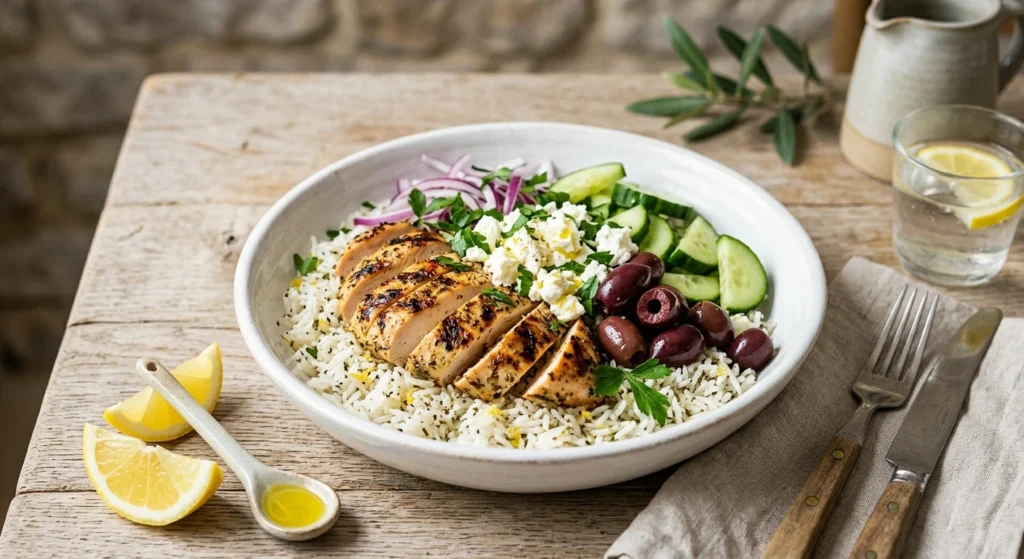
Mediterranean: swap thyme/paprika for oregano and lemon zest; finish with crumbled feta, kalamata olives, and a squeeze of lemon juice at the end.
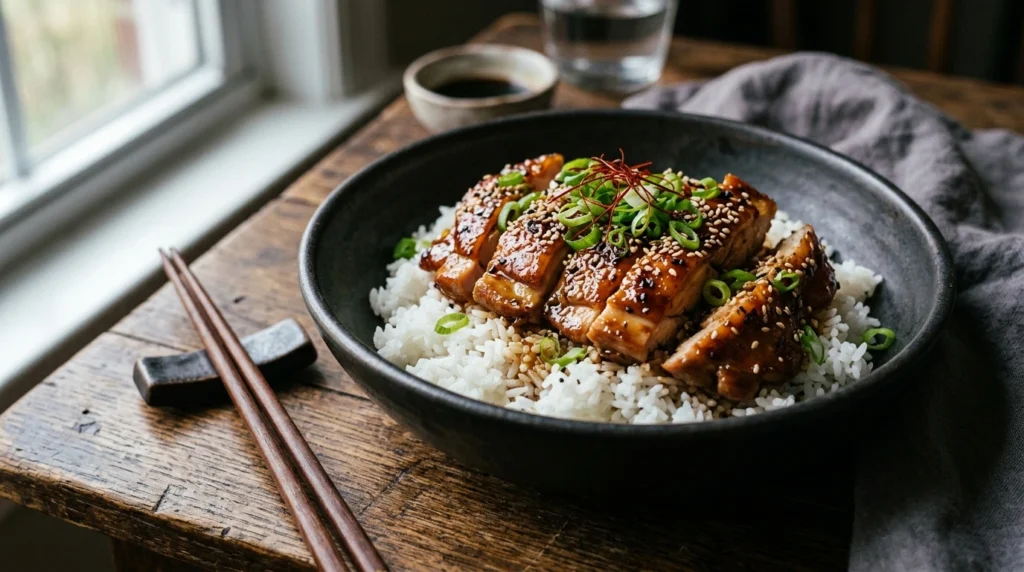
Asian-style: swap the spice mix for 2 tbsp soy sauce + 1 tbsp grated ginger + 1 minced garlic clove added with the broth; finish with sliced scallions, a drizzle of sesame oil, and sesame seeds off heat.
Substitutions: Can I Use…?
Brown rice instead of white? Yes — but it needs the 2.5:1 ratio and roughly double the simmer time (see the ratio table). Don’t substitute it 1:1 into the One-Pot method’s 18-minute timer; it’ll be crunchy.
Jasmine rice instead of long-grain? Yes, freely — actually the version I make most often. Drop the liquid to 1.5:1 and the simmer to 15 minutes, or it turns gluey. First time I tried it, I used the long-grain ratio out of habit and ended up with rice porridge — the extra starch in jasmine really does need less liquid.
Frozen chicken? Not for the One-Pot or Sheet Pan methods — it won’t brown and throws off cook times. For the Slow Cooker, frozen boneless chicken works, but add 1–1.5 hours to the times listed and always verify 165°F before shredding.
Chicken breast instead of thighs? Yes in all three methods — see the cut notes in each section. Watch it closer; breast has less fat margin.
Leftover cooked rice instead of raw? For One-Pot and Sheet Pan, no — those methods cook the rice as part of the recipe using specific liquid amounts. For a completely different (and faster) fried-rice-style approach using leftover rice, that’s a different recipe than this one.
Rotisserie chicken? Yes, and it’s a great shortcut — shred it and stir it in after the rice is cooked (any of the three methods), skipping the raw-chicken cooking steps entirely. Reduce the broth by about 1/4 cup since you’re not building fond from raw chicken.
Cauliflower rice? Not with this method — cauliflower rice releases water rather than absorbing broth, and the ratios here would make it soggy. It needs its own quick sauté technique, not a simmer-and-rest method.
Chicken stock instead of broth? Interchangeably, yes. Stock is usually richer (more body from bones); broth is lighter. Either works in any of these three recipes.
Wild rice? Not with these exact ratios or times — wild rice is a different grain entirely (technically a grass seed) with its own cook time (45–55 minutes) and roughly a 3:1 ratio. Treat it like the Brown Rice line in spirit, but test your specific package’s instructions.
Nutrition Adjustments
To add protein: stir a spoonful of plain Greek yogurt into your bowl after cooking (it also adds creaminess), or use an extra 100g of chicken per serving.
To reduce calories: use chicken breast instead of thighs, cut the olive oil in the One-Pot method to 1.5 tsp, and load extra vegetables into any of the three methods — they add volume without much caloric cost.
To make it dairy-free: none of the three base recipes contain dairy as written — only the Mediterranean feta variation does. Skip that swap and all three are dairy-free by default.
Common Mistakes (And Why They Happen)
| Problem | Cause | Fix |
|---|---|---|
| Mushy, clumped rice | Too much liquid, or stirred while simmering | Use the ratio table exactly; don’t lift the lid or stir |
| Hard or crunchy rice | Not enough liquid, or lid removed too early | Add a splash of hot broth, re-cover, give it 5 more minutes |
| Dry chicken | Overcooked past 165°F, or breast meat in a long slow-cook | Pull at 165°F exactly; use thighs for anything over 2 hours of cooking |
| Burnt bottom (stovetop) | Heat too high during the simmer | Lowest setting after the boil — if your stove runs hot, use a diffuser |
| Bland overall | Cooking rice in water instead of broth, or under-salting the liquid before it absorbs | Broth, not water; salt the liquid — you can’t fix it once it’s absorbed |
Storage, Cooling, and Reheating
Cool it safely first. Bacteria multiply fastest between 40°F and 140°F, so food shouldn’t sit at room temperature more than 2 hours [link: USDA “Danger Zone” food safety guidance]. Split leftovers into shallow containers rather than one deep pot — shallow cools faster, which is what actually keeps it safe, not how quickly you get it into the fridge.
- Fridge: airtight, 3–4 days.
- Freezer: up to 3 months; rice texture softens slightly on thawing but is still good in soups or casseroles.
- Reheat: add a splash of broth or water before heating — rice reabsorbs liquid readily and dries out without it. Microwave covered, stirring halfway; stovetop over low with the splash of broth, covered, until steaming through.
Can I double this recipe? Yes, for all three — for the One-Pot version, use a larger pot (the ratio scales linearly) and expect the initial boil to take a couple minutes longer to come back up to temperature. For the Slow Cooker, doubling works well since it’s already built for hands-off cooking and larger batches; just confirm your slow cooker is large enough that the liquid still covers appropriately.
Can I use frozen vegetables throughout instead of fresh? Yes for peas, corn, and similar quick-cooking vegetables — add them at the same point as the recipe’s fresh version (usually near the end). Frozen carrots get mushy in the sheet pan method specifically, since they’re already partially softened; fresh holds up better there.
FAQ
What’s the correct water-to-rice ratio for chicken and rice? 2:1 for long-grain white rice (2 cups liquid to 1 cup rice), 1.5:1 for jasmine or basmati, 2.5:1 for brown rice. Use broth, not water, for flavor.
Why is my chicken and rice always mushy? Almost always too much liquid or stirring while it simmers. Measure the ratio exactly and leave the lid on and undisturbed until the timer goes off.
Why is my rice still hard after the timer goes off? Usually a lid that didn’t seal tightly, letting steam escape, or a burner running cooler than expected. Add 2–3 tbsp of hot broth, re-cover tightly, and give it another 5 minutes before checking again.
Can I use chicken breast instead of thighs? Yes, in all three methods — just watch the temperature closely, since breast has less fat margin and can dry out a couple minutes past 165°F. In the slow cooker, pull breast meat earlier than the times listed.
Do I need to rinse the rice? For white rice, yes — it removes surface starch that causes clumping. Brown rice benefits less since more starch is trapped inside the bran layer, but a quick rinse doesn’t hurt.
Can I make this in an Instant Pot? Yes — brown the chicken using sauté mode, then pressure cook rice and broth together for 8 minutes at high pressure with a 10-minute natural release. The ratio and doneness rules above still apply.
How long does leftover chicken and rice last? 3–4 days refrigerated, up to 3 months frozen — provided it was cooled within 2 hours of cooking (see storage section above).
Can I cook this in cast iron instead of a Dutch oven? Yes for the One-Pot method, as long as it’s enameled or well-seasoned and has a tight-fitting lid — bare cast iron can react slightly with acidic ingredients like tomato, though there’s none in this recipe, so it’s not a concern here.
If You Remember Only Two Things
- Match your liquid to your rice, exactly — the ratio table at the top solves more problems than any technique.
- 165°F for the chicken, checked with a thermometer — not by color, not by time, not by guessing.
Everything else — which method, which spices, which cut of chicken — is just picking the version that fits your evening.
Cooking with chicken often? Our Ground Chicken Recipes guide has 24 more easy dinners using the same inexpensive protein, from Korean gochujang bowls to freezer-friendly meatballs.